"ChatGPT knows the internet. Zabrain knows you."
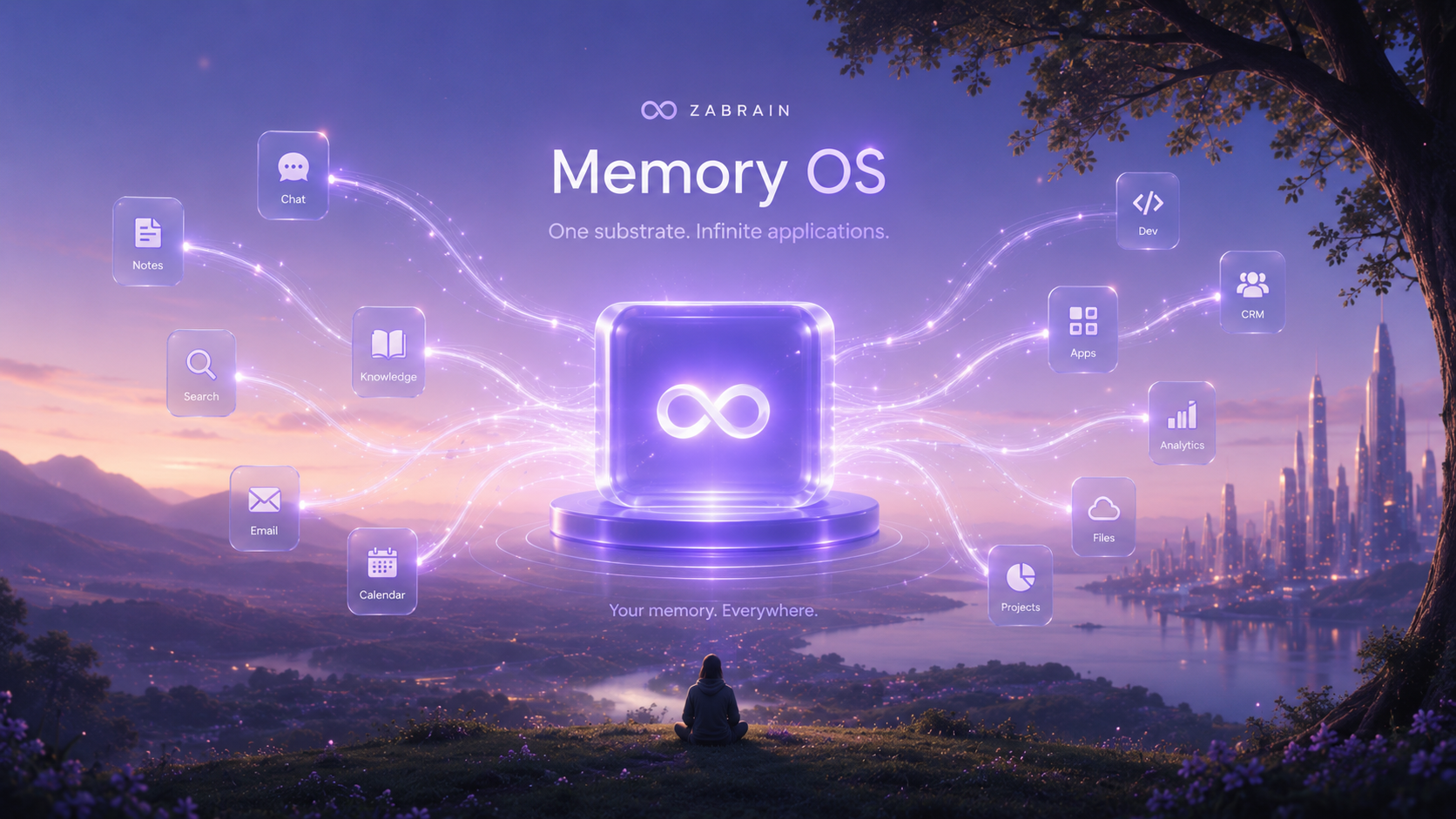
Zabrain is the Memory OS. The platform layer that was never built into the computer. Like macOS underneath every Mac app, Zabrain runs underneath every AI tool, every agent, and every workflow. The substrate captures your decisions, meetings, voice notes, and patterns automatically, with no manual input, and builds a structured understanding of you that compounds in value every day you use it.
The consumer product is a cloud desktop. Open it and your entire life connects: Fitness, Finance, Health, Work, Relationships, Food, Travel, Mind, Family, Education, Therapy. Seventeen sections, one graph underneath. Press Cmd+K from anywhere and the Brain Bar opens. Natural language dispatches to any section, any agent, any integration. This is the operating interface. The substrate is what powers it.
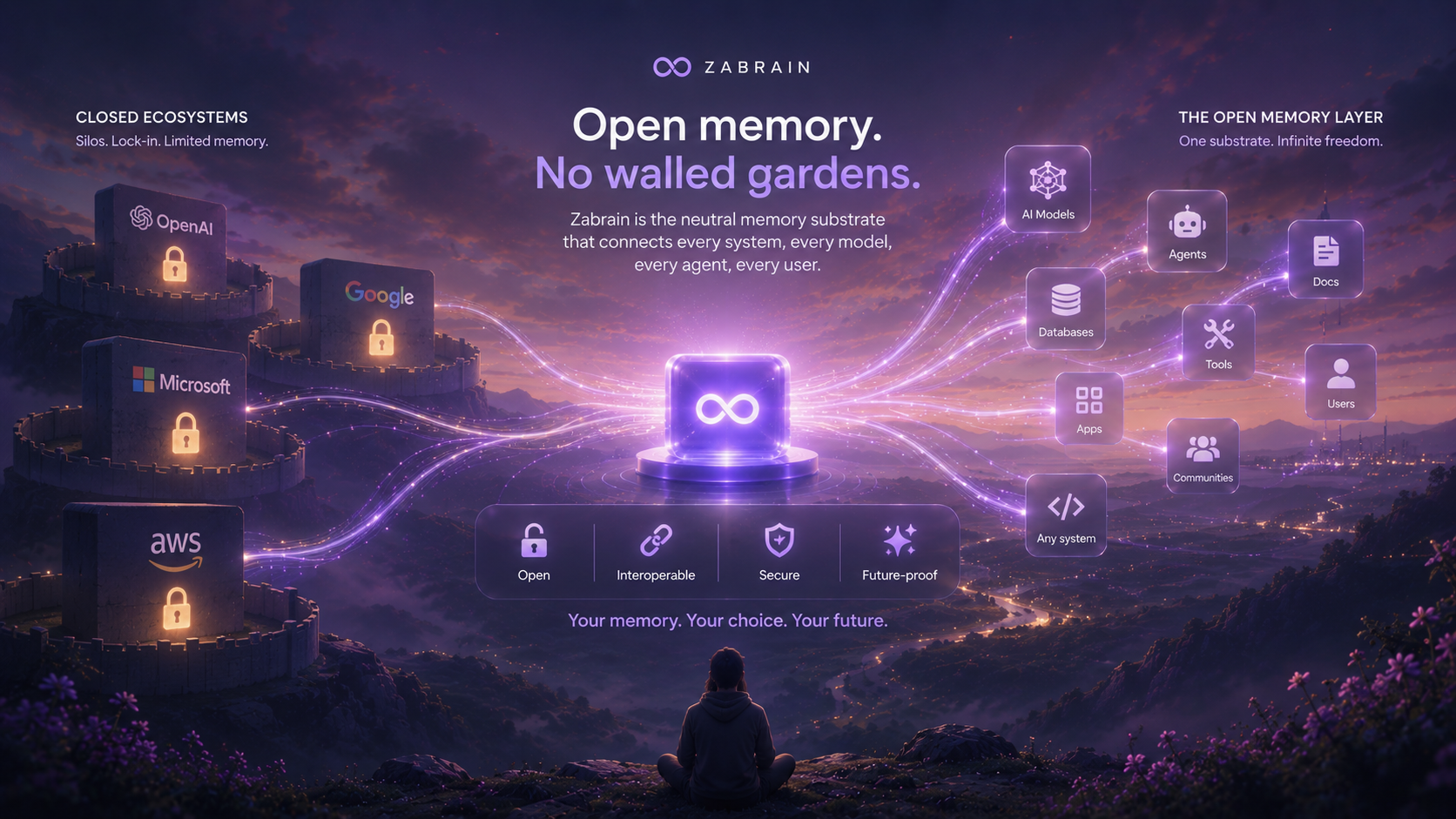
Every AI you plug into the substrate. Claude, ChatGPT, Cursor, any MCP-compatible model, reads from the same source of truth about you. You stop re-explaining yourself. The AI stops starting from zero. Cross-platform and user-owned by design; structurally impossible for any of the giants to replicate without breaking their own business model.
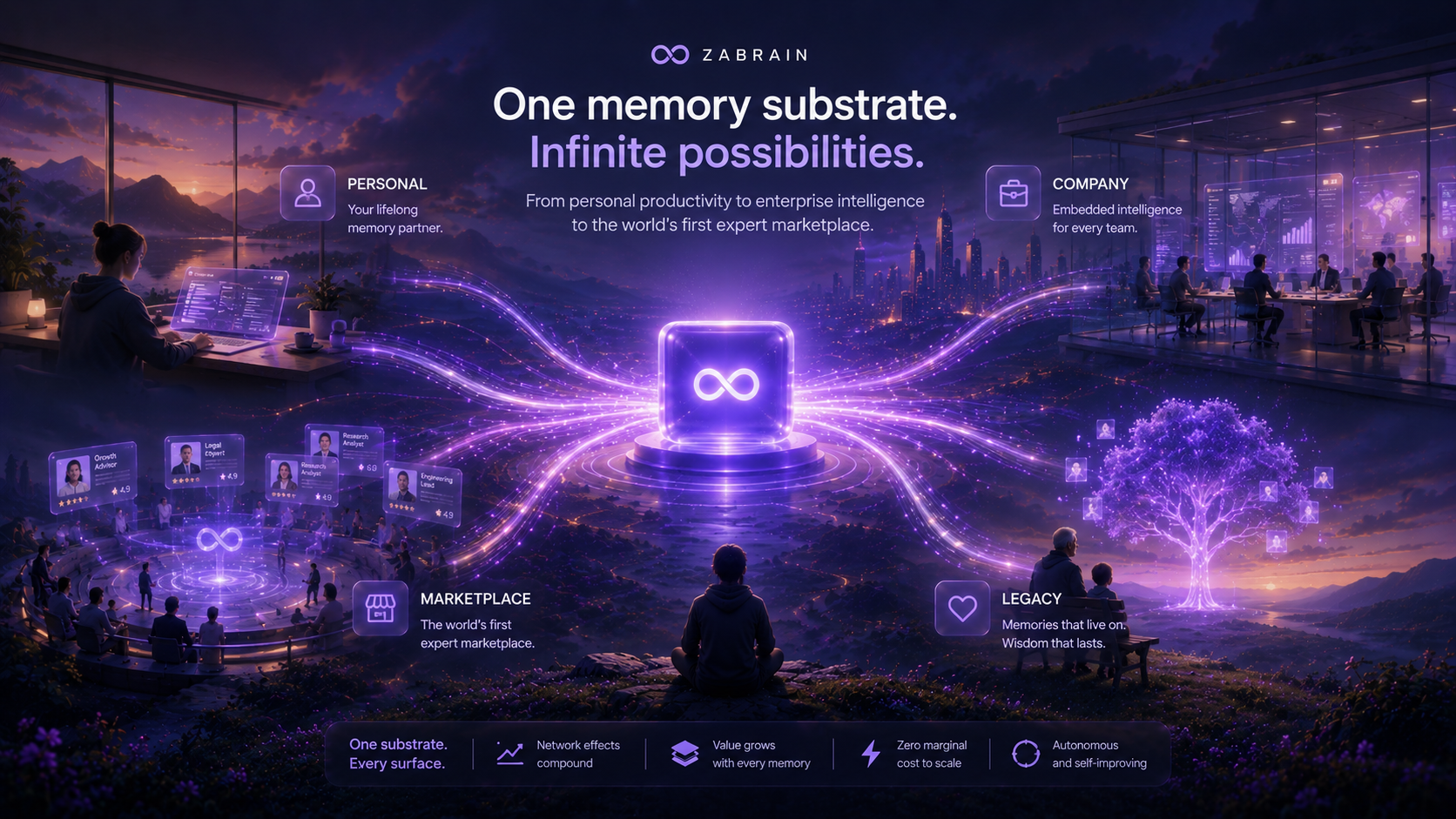
Four Surfaces. One Architecture.
| Surface | What It Does |
|---|---|
| Personal Brain | The consumer cloud desktop. Brain Bar, 17+ life sections, bento widget canvas. Your private knowledge graph underneath, everything you know, structured forever. |
| Company Brain | Institutional memory that survives headcount changes. When someone leaves, their knowledge stays. Same substrate, org-level access controls. |
| Expert Marketplace | Accumulated judgment runs autonomously. Revenue while you sleep. No time cap. |
| 100-Year Memory | Cognition survives the body. The first time this has ever been possible. |
All four run on one substrate. The substrate is the defensibility. Each surface requires the one before it. The architecture compounds across all of them.
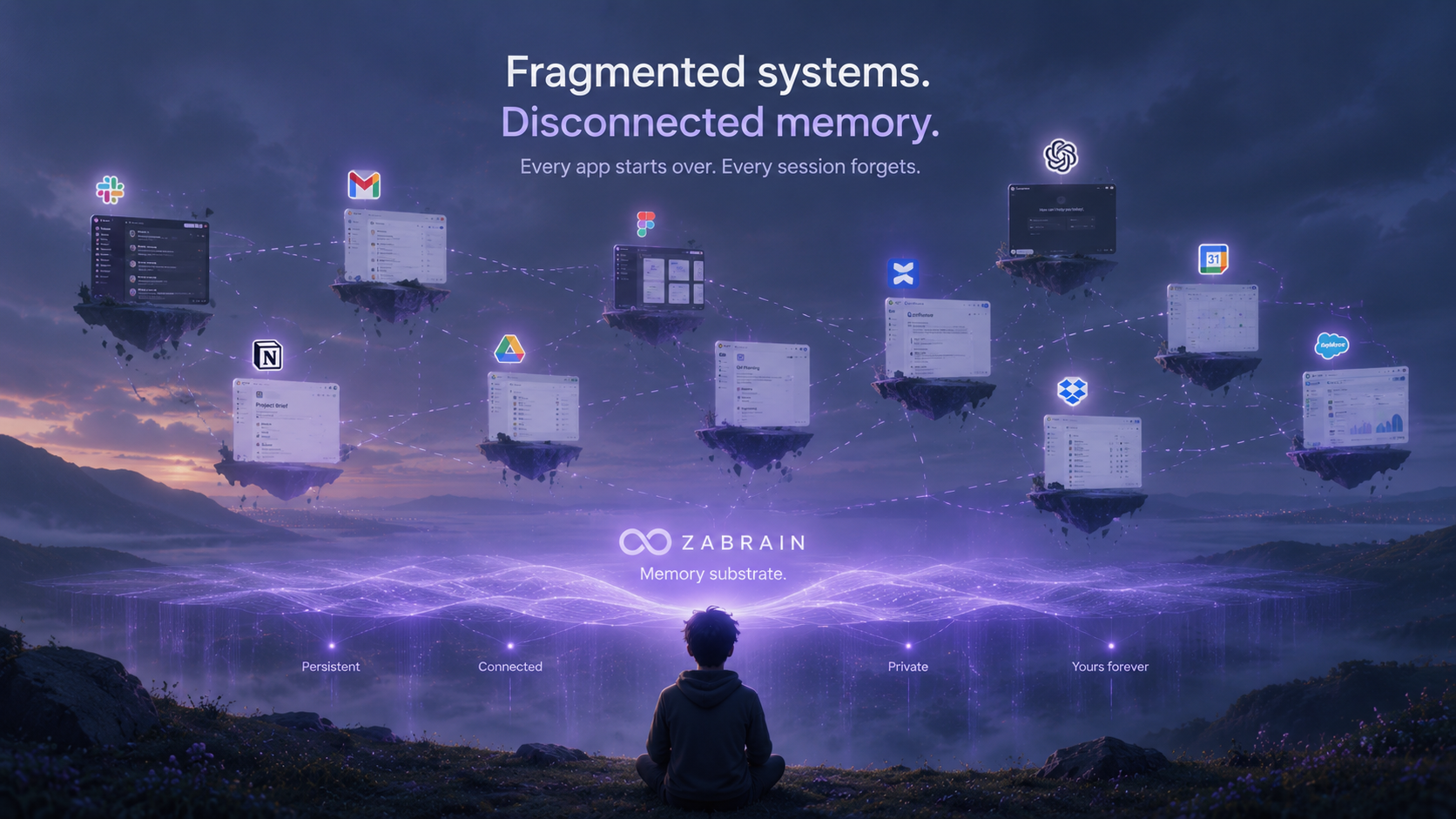
This isn't a product gap. Memory was never built into the operating system.
Why Every Existing Solution Fails
Notes apps store; they don't learn. Wikis rot the moment someone stops updating them. RAG systems retrieve documents but don't build understanding. AI assistants reset every session. Memory inside ChatGPT or Claude is locked to one ecosystem. The failure mode is architectural. You can't solve a memory problem with a storage product. You need a system that maintains itself: distills, connects, verifies, and promotes knowledge automatically, without ceremony.
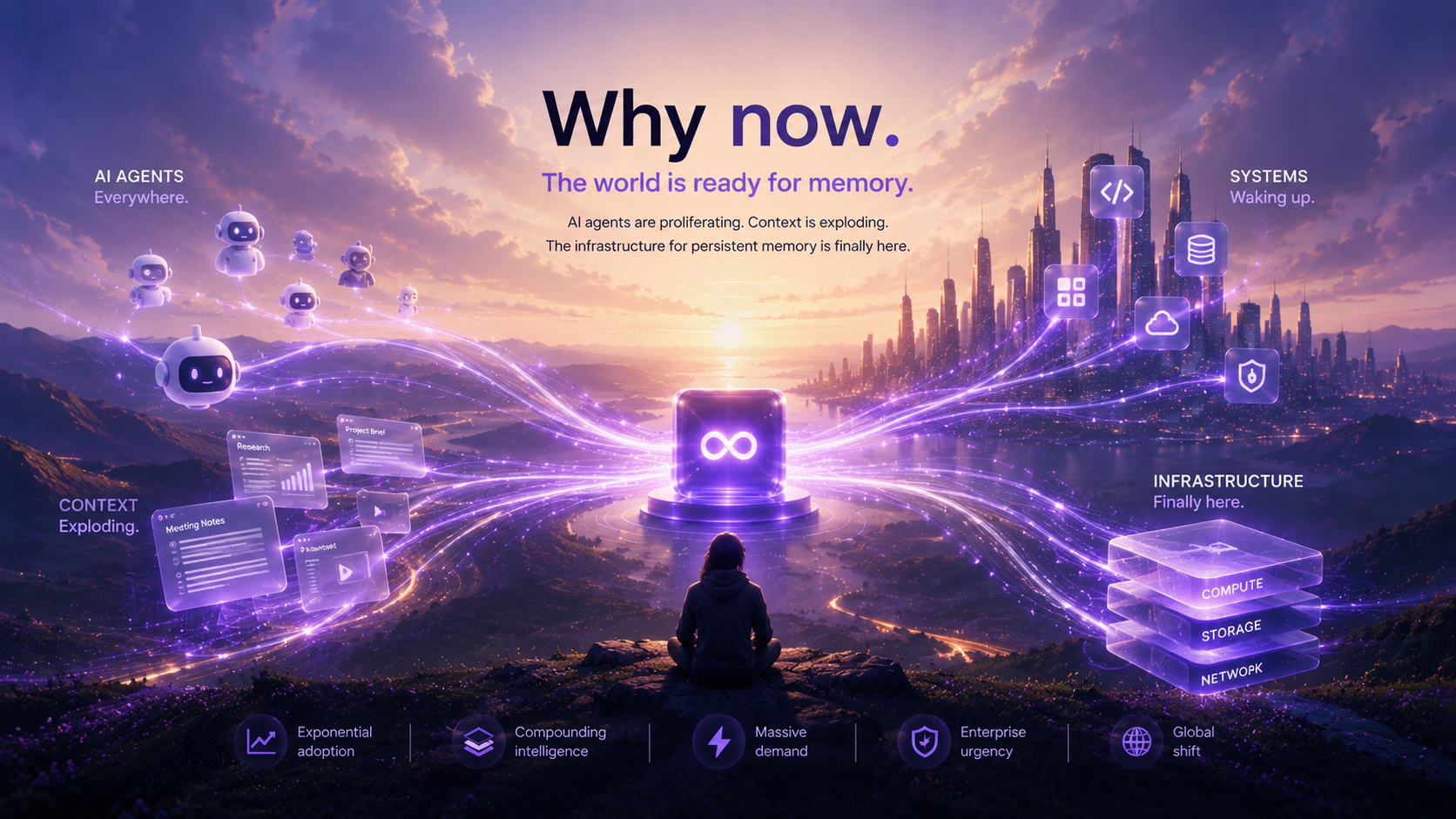
Capital Deployed. Category Validated
| Company | Raised | Who Backed It |
|---|---|---|
| Limitless | $33M → acquired by Meta | a16z, NEA, First Round, Sam Altman |
| Mem0 | $24M | Peak XV, Basis Set, YC S24 |
| Letta (MemGPT) | ~$14M | UC Berkeley origin |
| Supermemory | $3M | Series A |
| BlockBrain | €23M | European institutional |
| Zep | Undisclosed | YC + Root + Engineering Capital |
| Total deployed | $185M+ | Category confirmed at institutional scale |
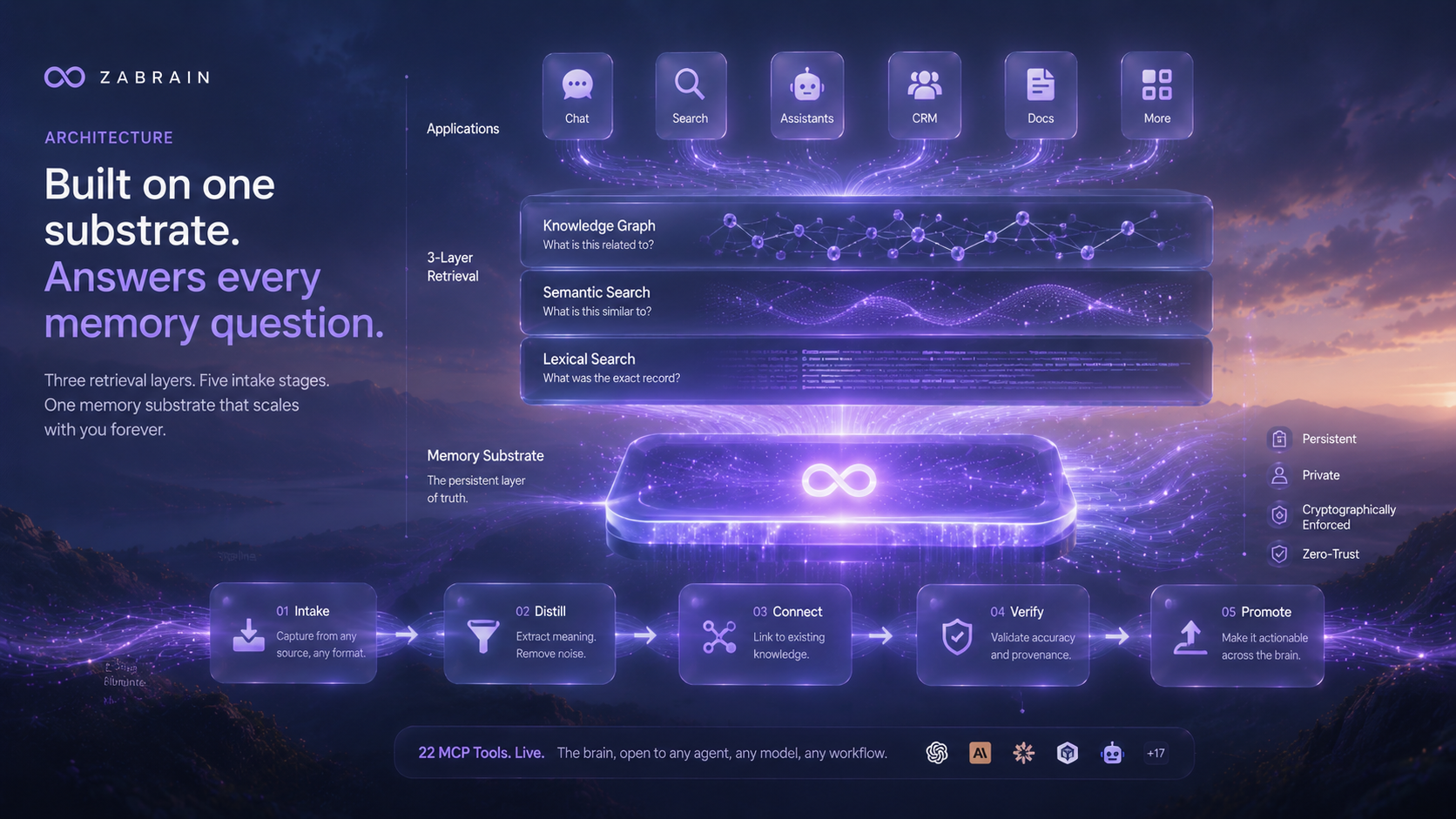
Everything runs on one substrate. The substrate is the defensibility. Most competitors use one storage layer. We built three, composited, because they answer fundamentally different questions.
Three-Layer Retrieval
| Layer | Technology | Answers |
|---|---|---|
| Knowledge Graph | Neo4j, typed relationships, time-weighted traversal | What is this related to? |
| Semantic Search | pgvector, embedding-based similarity | What is this similar to? |
| Lexical Search | Full-text, keyword-based retrieval | What was the exact record? |
Five-Stage Intake Pipeline
Nothing promotes to the canonical graph automatically. Every fact passes through five stages. Every node has a traceable history, can be rolled back, and is actively maintained by agents running in the background. The brain never silently overwrites old truths.
22 MCP Tools. Live
The brain exposes 22 tools via the Model Context Protocol. Any MCP-compatible AI (Claude, ChatGPT, Cursor, any agent) plugs in and uses the brain as its source of truth. Key tools: orient_brain (full context snapshot of everything relevant now), search_brain (semantic + graph traversal), capture_knowledge (write to graph), absorb_content (long-form → structured nodes).
Zero-Trust RBAC
Information that a connection doesn't have access to literally doesn't exist to that connection. Not filtered, nonexistent at the query layer. This is what makes Company Brain viable for enterprise: an employee can't leak what the graph never shows them. Personal and company memory boundaries are cryptographically enforced.
Consumer Layer
The substrate is what powers it. The consumer interface is what users open. A cloud desktop: bento canvas of widgets, each connected to the memory engine in real time. Press Cmd+K anywhere to open the Brain Bar. Natural language dispatches to any life section, any agent, any integration. Seventeen life sections organized into one view: Fitness, Finance, Health, Work, Relationships, Food, Travel, Mind, Family, Education, Therapy and more. Developers build Brain Apps on the same substrate via the brain.js SDK. Every app on the platform compounds the graph for every user on it.
What's Live Today
| Component | Status |
|---|---|
| Memory engine (graph + vector + pipeline) | Live, running daily |
| MCP server. 22 tools exposed | Live |
| Zero-trust RBAC | Live, enforced at tool-call layer |
| Git provenance on all canonical nodes | Live, full rollback |
| Internal Company Brain (Edan Labs) | Running, all decisions in graph |
| OS shell. 148 routes | Built. wiring to memory engine now |
| Brain Bar + widget canvas | Sprint 1. active build |
Phase 0 Gate
The current sprint has one pass condition: 10 named users, 7 days. 8 of 10 send an unsolicited message (text, voice note, email) saying some version of "how did it know that?" No coaching. No prompting. Binary pass/fail. This is the only signal that can't be gamed. Everything downstream (MRR, retention, growth) is downstream of this moment.
Category Map
| Category | Who | Their Ceiling |
|---|---|---|
| Developer Infrastructure | Mem0, Zep, Letta | No consumer product, no lifecycle, no provenance. Different buyer entirely. |
| Enterprise Document RAG | BlockBrain | Static retrieval. No cross-session learning. Wrong category. |
| Consumer Personal Assistant | OpenHuman, Supermemory | Flat storage architecture. Can't scale to Company Brain or marketplace. |
| Giants | Apple, Google, OpenAI, Microsoft | Locked to one ecosystem. Golden cage. Structurally cannot go cross-platform. |
| Memory OS | Zabrain | The substrate beneath all apps. This is us. |
vs Mem0. Most Common Comparison
Mem0 (YC S24, $24M) builds memory for AI apps, a developer SDK. Four-line integration, 90,000 developers using it. Mem0 builds memory for AI apps. Zabrain builds memory for the human coordinating across all their AI tools. Different buyer (developer vs. individual), different scope (one app vs. all apps), different defensibility (four-line SDK vs. compounding knowledge graph with lifecycle). Mem0 → tool. Zabrain → OS. We're not competing for the same customer.
vs The Giants. Why They Can't Win This
Every giant is building memory locked to their ecosystem. This is structurally required by their business model; they need you inside their platform. A user's Zabrain brain works with Claude, ChatGPT, Cursor, and every MCP-compatible tool simultaneously. The giants cannot offer this and maintain their business model. We can. Every time a user has to choose between their preferred AI tool and their memory, we win.
Enterprise Problem in Numbers
| Data Point | Source |
|---|---|
| $31.5B lost annually by Fortune 500s to knowledge management failure | Industry research |
| 254 average enterprise apps per organization, all siloed | Industry research |
| 2.5 hours lost per day per knowledge worker on information already in the org | IDC |
| Replacing a senior knowledge worker costs 50–200% of annual salary | MIT Sloan |
The Moat Has a Timer
The brain compounds with time. A user at 30 days has a useful tool. A user at 3 years has an irreplaceable asset: years of decisions, voice notes, meetings, patterns, all structured and retrievable. No competitor can retroactively give a new user 3 years of accumulated memory. Switching cost grows non-linearly. That's not a feature. That's a moat with a timer, and the timer is running now.
Personal Brain. Consumer SaaS
| Tier | Price | Purpose |
|---|---|---|
| Free | $0 | 1K nodes, 3 capture sources, habit formation and virality |
| Pro | $25/month | Unlimited graph, all sources, primary paying tier |
| Power | $250/month | Deep integrations, priority compute, API access |
Company Brain. B2B SaaS
PLG motion: Personal Brain power users become internal champions who pull Company Brain into their organizations. No cold outbound. Bottom-up by design.
| Tier | Price | Notes |
|---|---|---|
| Team | ~$50/seat/month | Small teams, SMBs. entry point |
| Business | $99/seat/month | Primary B2B revenue tier |
| Enterprise | $50K–$200K ACV | Custom contracts. SOC 2 in progress, required to unlock Fortune 500 motion |
Expert Marketplace. Platform Take Rate (Year 3+)
An expert's accumulated judgment runs autonomously. Zero marginal cost once the substrate is validated. Revenue scales with usage, not with expert hours.
| Mode | Take Rate |
|---|---|
| Live session (expert present, brain enriches context) | 10% |
| Async (brain drafts in expert's voice, expert reviews) | 15% |
| Brain-only (expert's brain responds independently) | 20% |
100-Year Memory. Annual Subscription (Year 4+)
Premium positioning. Annual subscription, no direct competition. Pricing power is high; there is no alternative. The estate planning market ($60B+) creates pricing floor analogies.
The LTV Arc. No Competitor Has This
A brain user at Month 1 is paying $25/month. At Year 3–5, they're monetizing via the expert marketplace. At some point, they configure 100-year memory. LTV of a serious user extends across their lifetime. No other productivity product monetizes across a human life arc. The switching cost after Year 3 exceeds any price point a competitor can undercut.
Revenue Targets
| Milestone | ARR Target | Driver |
|---|---|---|
| Month 5 | $50K | Personal Brain public launch. If not hit: diagnose funnel before any further spend. |
| Month 8 | $500K | First enterprise Company Brain contract. SOC 2 complete. YC cohort onboarding. |
| Year 1 | $2M | Zero paid acquisition. Company Brain pilots beginning. |
| Year 3 | $10M+ | Company Brain B2B compounding. Expert marketplace launches. |
The three functions that typically take a startup three years to assemble. product vision, technical substrate, and Day 1 distribution, are present from the start. Co-founder relationships predate the company by years. Trust was built through execution before equity was formalized.
What he has shipped since: Vinculum, a professional marketplace whose architecture became the standard substrate every Edan Labs product inherits. Learn The Markets, a trading education business that generated $5.2M in tracked student profits. Veritrade, a live broker-connected verification platform he built v1 of in three weeks while bedridden recovering from surgery and raised the first check before he was back on his feet. BankForBots, the first bank account built for AI agents, real virtual Visa cards via Stripe with isolated spending identities and per-transaction limits, built in six to seven hours when the team needed it. CreatorOS, a seven-agent content operations system deployed live with creator agencies. And now Zabrain.
The conviction behind Zabrain is not new. In 2019 he built Memoriam, an early substrate for preserving cognition beyond a lifetime: what happens to a person's accumulated knowledge, reasoning patterns, and judgment when they die. The stack couldn't support what he envisioned. He filed it away. Then day two of ChatGPT's public launch, November 2022, the thought came: "The most powerful AI ever built has zero memory of me. Five years from now, it won't know what we talked about today." He started building immediately and has not stopped. Memoriam became one of four surfaces. The original question became the company.
This is not a trend he spotted. It is a problem he has held for years, quietly, while building every adjacent system that would eventually make it possible.
Ships production code on Zabrain daily. He is not a CEO who manages engineers. He is an engineer who runs the company.
He took Veritrade from a bare-bones MVP built on early frontier AI to a fully deployed Beta v2.2 with a team of five developers, real engineering workflows, and infrastructure ready for scale. Along the way Daniel surfaced a need the whole company felt: memory persistence and synchronization across the entire team. Alfred built it from scratch. The knowledge graph, the retrieval architecture, the intake pipeline, the access control layer. All of it. He became a permanent co-founder the way the real ones do — by solving the hardest problems before being asked to.
What he built on Brain: A three-layer retrieval system composited together — semantic vector search for meaning, lexical search for keywords, and a knowledge graph for relationships. Most products use one layer. Alfred built all three. The intake pipeline doesn't dump raw data into a database — every piece of information passes through an agentic filter that reads what's already in the brain, makes sense of new intake in context, creates connections, and breaks old ones as needed. The access control architecture makes information a connection doesn't have access to literally nonexistent at the query layer. Not filtered — nonexistent. That is the enterprise primitive.
What he built on Veritrade: The entire platform backend — from simple user interactions to a metric calculation engine that orchestrates five-plus data feeds and tackles industry-level data handling challenges, turning a user's click into their public profile without them bearing any of the complexity. Live broker connections across 15-plus institutions.
University of Florida, third year, studying abroad in Switzerland. Building full-time. Every major technical decision since day one. He didn't get hired to maintain a product. He showed up and built the thing that made everything else possible.
He is the operational backbone. While Daniel and Alfred build, Antonio runs everything that moves the company forward: GTM, distribution, partnerships, and the community relationships that give every Zabrain product a warm launch. He identifies what needs to happen next and does it without being asked. The company does not stall when the founders are heads down building.
Not technical by design. Every great founding team needs the person who makes the builders unstoppable. Antonio is that person.
Engineering Team
Engineering: Michael Davidson, Riley Lamont, and Isaac Porat. Nick Granberry sits as Head of Sales. Alfred leads all technical architecture and owns the full engineering direction. Georgia Tech is an active sourcing channel for additional engineering hires as the team scales.
Use of Funds
Capital goes to three areas: the people who close the technical gaps fastest, the hardware that unlocks the enterprise deployment model, and the compliance that opens Fortune 500 doors. Nothing else.
Team
| Role | What They Unlock |
|---|---|
| ML Engineer | Retrieval quality, model fine-tuning, data pipeline hardening from day one |
| Cybersecurity Engineer | Enterprise-grade RBAC, zero-trust infrastructure, breach prevention at the architecture layer |
| DevOps Engineer | Scalable deployment for both SaaS and self-hosted enterprise variants |
| Head of Design | Consumer interface that non-technical users understand on first sight, no onboarding required |
Hardware
| Item | Why It Matters |
|---|---|
| NVIDIA DGX Spark | Runs local chunking, embedding, and reranking models simultaneously. Required for the self-hosted enterprise deployment model. |
Compliance
| Item | Why It Matters |
|---|---|
| SOC 2 Type 1 (~$18–22K) | Required gate for Fortune 500 Company Brain contracts. Security infrastructure built in from day one, not retrofitted. |
Why This Bet, Why Now